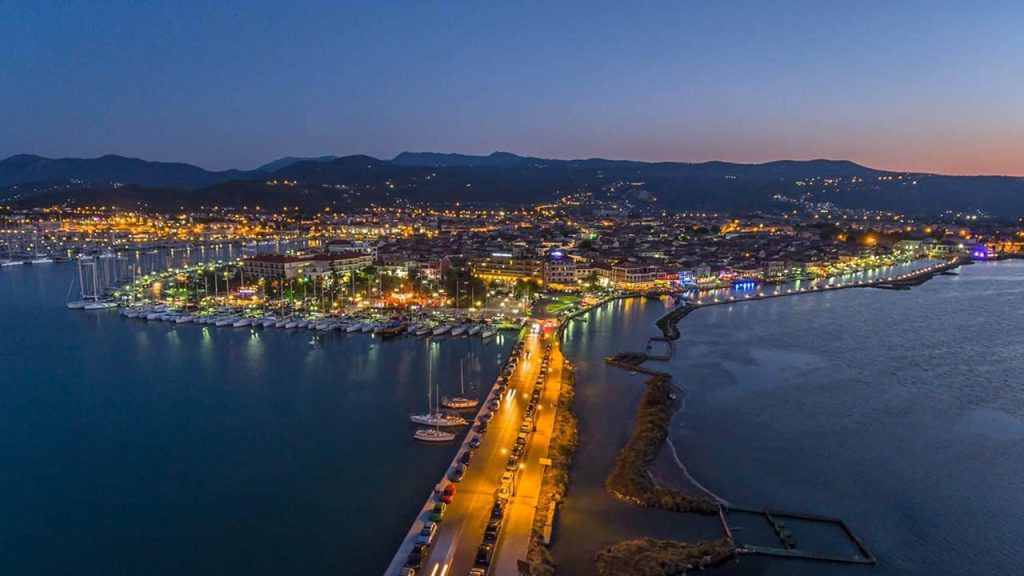
At the northeastern end of the island of Lefkada, very close to the mainland coast, as soon as we cross the arched bridge, we are greeted by the capital of the island, the Lefkada. The town with its tiled, timber-framed buildings and the green landscape around it has its own character. The old town has medieval characteristics and its humility touches visitors.
Just outside the town, the fortress of Agia Mavra, built next to the lagoon, remains its sleepless guardian and protector since the 14th century and has much to tell us. The fortress of Agia Mavra was built by the Franks in its original form in 1300 and is a model of fortification art. Battles with fierce pirates, fierce resistance to the Turks, but also to time and earthquakes.
There the flag of the Independent State of Ionian Islands was raised in 1810. For a long period of time in the month of August it hosted the Literature and Art Festivals and the International Folklore Festival.
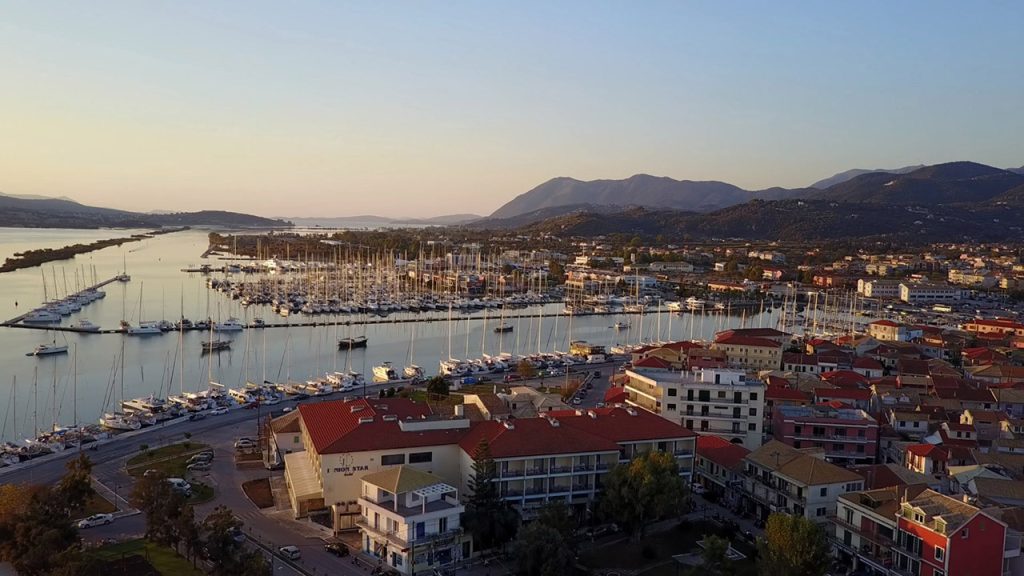
In the port of the town many services are concentrated to serve visitors, from hotels to boats for day trips to the surrounding islands. The central square is the place of daily meeting, where the church of Agios Spyridon, the first church of the city, dominates the western side of the square and is characterized as a religious, cultural and historical monument.
In the town of Lefkada one can visit:
- The Archaeological Museum is housed on the ground floor of the Town Hall of Lefkada and is one of the most remarkable in Greece.
- The Folklore Museum of ORFEA, housed in a traditional building, was an old mansion, in the central market street near the central square.
- The Museum of Post-Byzantine Art which is located on the upper floor of the Public Library of Lefkada which is housed in a neoclassical building in the heart of the old town.
- The phonograph museum which is private and located in an accessible location in the central market street.
- The Haramogleia Special Lefkadian Library (H.E.L.BI) which belongs to the Municipality of Lefkada and is located on the upper floor of a traditional two-storey municipal building in Marka. The H.E.L.BI, the life's work of the late Teli Charamogli, contains a rich and rare material as well as everything that has been written about Lefkada and at the same time everything that Lefkadians have written in all fields of Science and Art. On the ground floor there is the Art Hall of the Cultural Centre of the Municipality of Lefkada which bears the name of the great Lefkadian painter of international fame, the late Theodoros Stamos, in which exhibitions of painting, sculpture, engraving, photography, etc. are held annually.
- The historical library of the late Nikos Svoronos which is housed in the upper floor of a two-storey municipal building and which will soon open its doors to researchers and the public.
- The Municipal Gallery which is housed on the ground floor of the Town Hall of Lefkada and contains paintings by one hundred (100) foreign and Greek artists, who have presented their works for twenty (20) years in the exhibition halls of the Cultural Centre of the Municipality of Lefkadia.
- The churches of the city that date back to the 17th century and have rare hagiographies and remarkable iconostasis.
- The offices of the cultural associations of Lefkada. The Philharmonic, Orpheus, the New Choir, Teliokratis and others.
- The sights of the city, Gyra, Agios Ioannis, Vlaherna, Agia Marina, Agia Maura Fortress are located a short distance from the city with easy and unhindered access.
- The Monastery of Faneromeni which is the patron saint of Lefkada and an important place of pilgrimage. It is located 3 km outside the town and celebrates the feast of the Holy Spirit. The location of the monastery of Kyra-Faneromeni offers a magnificent view.