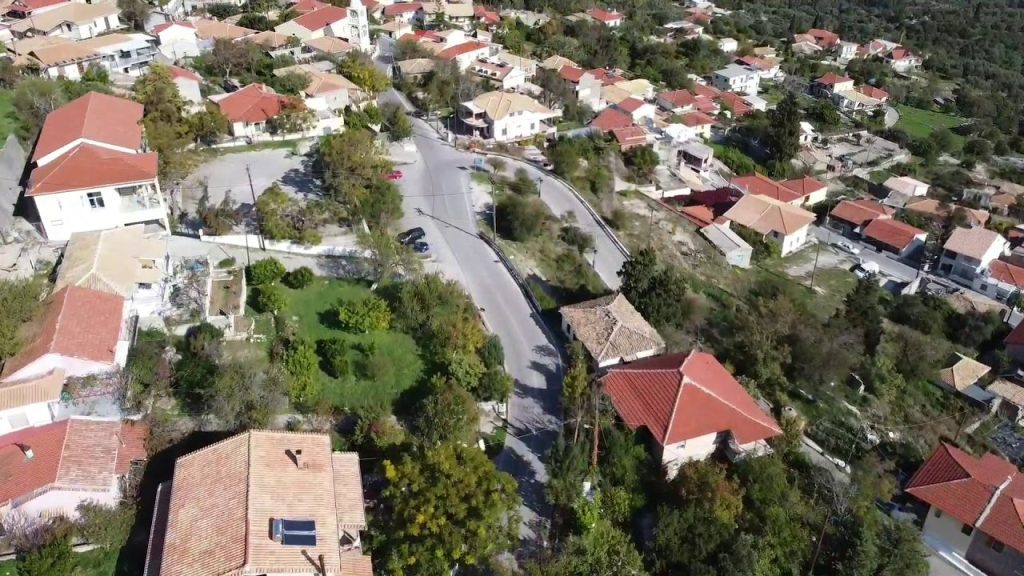
Just before the lighthouse, the road leads to the monastery of Agios Nikolaos Iras or Niras, a remarkable historical monastery founded probably in the early 17th century, in 1637 or even earlier. It was built by seven families who dedicated a large property to it. The present church is later. Its iconostasis is contemporary with its icons made in 1799. Thirteen twelfth-century icons and three despotic icons are the work of the hagiographer Andreas Betzos. They are all painted with special egg paint on the plank and are all preserved in fairly good condition. The despotic icon of St. Nicholas is the work of another well-known hagiographer, Dimitrios Foskaris from 1699. It is the oldest inscribed and dated portable icon of Lefkada, which was stolen and rediscovered in 1979 with much damage. Today it is kept in a building of the monastery in the village. Athani. The monastery has no frescoes. The last monk who practiced there died in 1949.
The lighthouse of Lefkata was built on an ancient temple dedicated to Apollo. The main sanctuary of Lefkada, which is often mentioned in ancient sources, was that of Apollo Lefkatas. It is located at the southern end of the island, on the steep homonymous promontory known as Dukato or, as it is mentioned on old Italian maps, as Salto di Saffo (Sappho's Leap). On the top of the hill, W. Dorpfeld found remains of ancient buildings belonging to the complex of the mosque, The site of the temple is now occupied by the modern stone lighthouse of Lefkata. According to ancient writers, human sacrifices were the main part of the annual festivals in honour of Apollo. Over time, efforts were made to moderate this barbaric custom. Thus it seems that at some point, unknown when, they began to use convicts for the sacrifices.
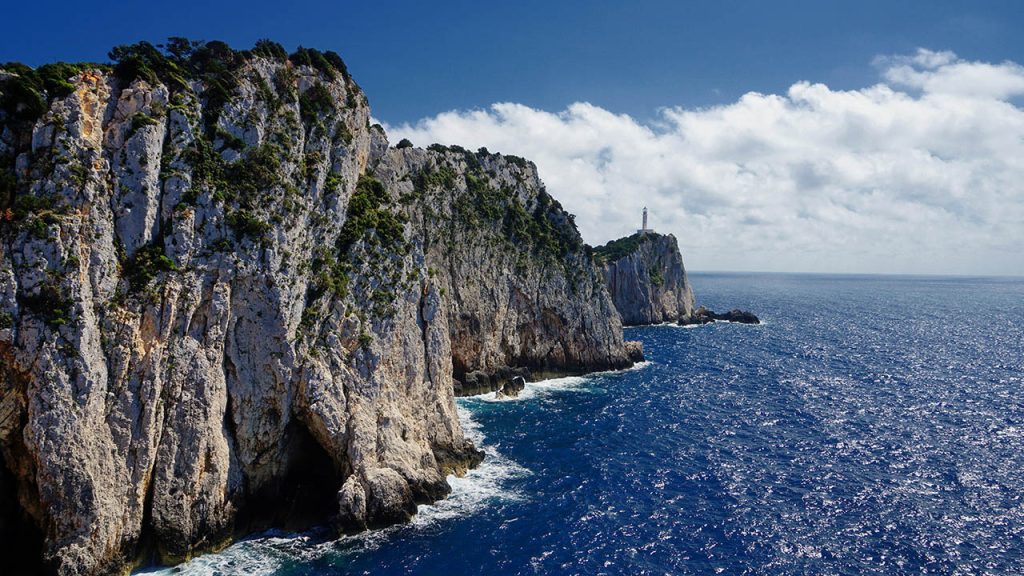
As Strabo (1st century BC - 1st century AD) mentions, during the annual festival of Apollo, a convict was chosen as a scapegoat and thrown from the rocks of the cape into the sea. Such feasts survived until Roman times. The victim is charged with all the negative elements and sins of the city and by his offering he purifies them.
The legend of Sappho's fall from the rocks of Lefkata, because of a failed lover, is very likely connected to the purgative properties of Apollo. Ancient writers, beginning with the poet Anacreon, often referred to famous and anonymous people who fell from the cliffs of the cape to find an outlet for their amorous passions. Thus, in 4th century BC comedies, Lefkada appears as a synonym for unsuccessful love and purification.
After the victorious naval battle of Augustus at Actium (31 BC), which was attributed to the contribution of the god Apollo, whose sanctuary was located near the site of the battle, Apollo of Lefkatas is called Lefkadios and Aktiakos. «And in Lefkadi there is a high water and Apollo is founded, and those who honour him call him Aktaion» (Aelianus, De Natura Animalium , XI 8).
Today few traces of the ancient temple can be seen under the lighthouse. But the landscape is so impressive that it conveys to the visitor the magic of its mysterious character.