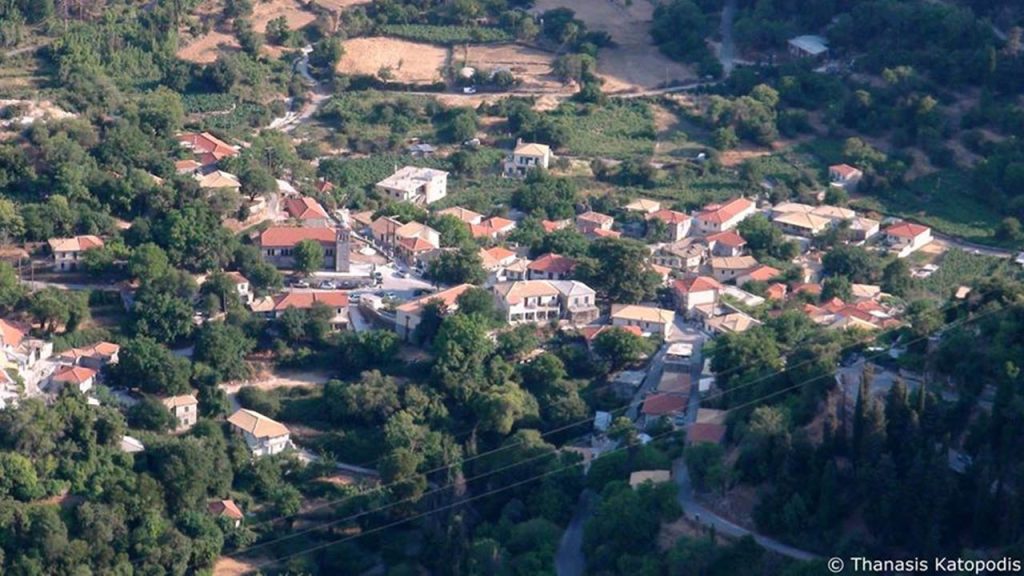
Four kilometers after Karya, at an altitude of about 730 meters built on small hills, is the Enclave. The most mountainous village of the island. In the shadow of the now defunct American radar, which dominates the highest point of the village, Egluvi is revealed: Stone houses with arched courtyard doors, jewels of folk art, which evoke beautiful memories and moments, make us reminisce about romantic times, combining yesterday with today, today with tomorrow..., cobbled streets, the square with plane trees and mulberry trees, women in traditional Lefkadian costume, the smiling proud and yet hospitable Egluvians.
The main occupation of the inhabitants is the cultivation of the well-known lentil Engluvius which is rightly considered the best and the tastiest in Greece, as well as the viticulture. A little further up from the village and at an altitude of 900 meters the visitor will find the chapel of Agios Donatos, which celebrates on August 7. On the day before, there is a festival in the area and the Egluvisane housewives cook lentils in the traditional way in large pots and treat the visitors with olives, salted sardines and wine.
Opposite the chapel there is a series of wells with water “krustallo” and in the surrounding area threshing floors, windmills, the settlement of the volta are monuments of an unsurpassed culture that can not leave any visitor unmoved. The Volti are located exclusively in this place and their construction was imposed by the special cultivation conditions of the area. Inside each volta there was a small household to serve the farmers who lived there all summer. The countless voltae (small domed stone houses in the shape of an oven) are proof that the area of Agios Donatos was in the distant past a bustling summer settlement full of life. After the necessary pilgrimage to this varied landscape with its primeval charm, above the plateau of Agios Donatos on one of the highest peaks, the visitor comes across the chapel of the “high’ guardian, the Prophet Elias. Researchers claim that the walks are of Homeric times. K. Doukas says that ”Homer - Odysseus used them“.