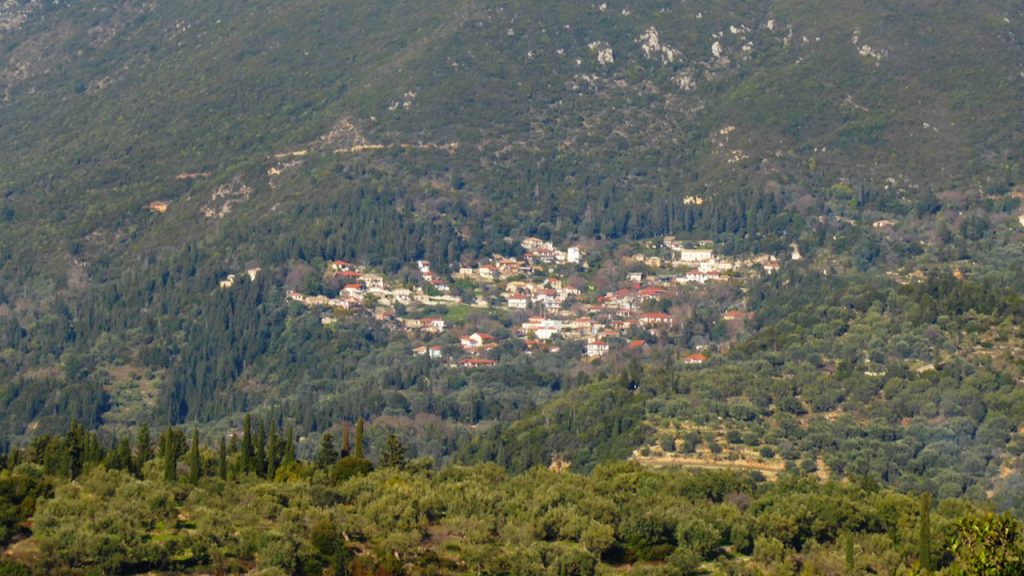
5 km. from Vasiliki is the village Vurnica, in a quiet and peaceful landscape, in Rodaki, from where the whole bay of Vasiliki can be seen, the ruined monastery of Agios Ioannis, one of the most interesting monasteries of the island, is preserved. It is believed that it was built in 1654.
The temple is built on the floor of a large ancient Doric temple, probably dedicated to the goddess Demeter, goddess of agriculture and fertility. That is why the tradition prevailed that any childless couple who attend the church and step on the threshold of the entrance will have a child. Traces of the ancient temple still survive, such as Doric capitals and part of the paved floor. The original church was repeatedly extended, the monks’ cells were enlarged and auxiliary rooms were created. Around the end of the 18th century, the monastery came into public ownership and in 1797 it was ceded to the monastery of Asomatos of Vaukeri. The church is preserved in fairly good condition, within a spacious enclosure. It has two entrances and a women's loft on the same level as the main church. Parts of the frescoes on the eastern wall of the church are preserved in good condition and are an example of excellent style. In the niche of the sanctuary, the austere figure of Platytera can be seen. In the front, the Extreme Humiliation is depicted, followed by the first martyr Stephen and St. Romanos. Despite the deterioration of the representations, their delicate, elegant art is evident.
In Vournika there is also the church of Agios Ioannis the Baptist. It was a private church and belonged to the Karavia family. It is considered to be the oldest church of the Byzantine period in Lefkada, even before the monastery of Odigitria. It is a single-aisled basilica like most of the churches on the island, built with a clay structure and a wooden roof. In the niche of the north wall, a figure of an unknown saint was discovered, dating back to the end of the 11th and beginning of the 12th century. The rest of the frescoes of St. John of the Caraviades are later, from the 17th century. The east side is registered. It is distinguished in the lower zone “of Heaven the Platytera” The representation of the Ascension on the front of the side is large and multifaceted. The frescoes are influenced by the Cretan school.