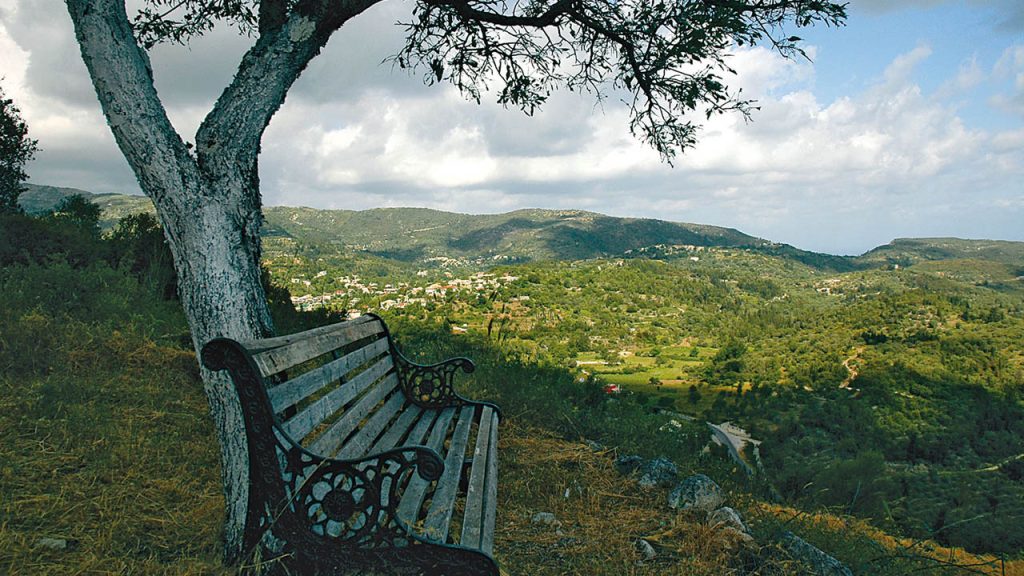
The view that one can enjoy from all the villages of Sfakiotes, either towards the town of Lefkada or towards the sea to the east and west, is unique. Also the hills around the villages compose a landscape of natural and built environment, which will surely move the visitor. Traditional stone houses, churches, bell towers, windmills, watermills, springs, wells, are the identity of the area. Here is a multitude of paths and hiking trails that are worth enjoying.
For example:
Spanochori (location Katapotiras) - chapel of Prophet Elias.
Chapel of Prophet Elias - Agios Stefanos (church in a cave, with a unique view to the east side of the island).
Dasillia Trail «Throbero», in Lazarata.
From Kavalos, the path Rachi - Kali, Kali - Prementinos, Prementinos - Agios Spyridon, to Lazarata.
Lemomi - Spilia - Kionia - Lario - Kaloira - Fasu - Xoveloni
Also in the Melissa Gorge and throughout the wider area, just outside and north of the village of Kavalos, you will find a network of paths and hiking trails. Here, in the area of Melissa, there are ruins of small settlements, old watermills, many stone bridges, wells and springs, such as that of the «Cave» from which crystal clear waters still gush forth and the visitor can quench his thirst, rest and relax.
You will get there, leaving the town of Lefkada, after taking the provincial road to the municipality of Sfakiotes. After 6 km you will reach the place where the Municipality of Sfakiotes built the Monument to the revolt of the peasants against the British Protection in October 1819, then you will turn right on the asphalted rural road and cross a path through wonderful olive groves. After 3km you will turn right following the rural dirt road a lovely 2km route that will take you to the entrance, the entrance to the Melissa Gorge.
There is a stone bridge and the «Cave» which is naturally dug into a huge rock. There you will also see the famous homonymous spring where crystal clear waters gush out and you can quench your thirst and rest.
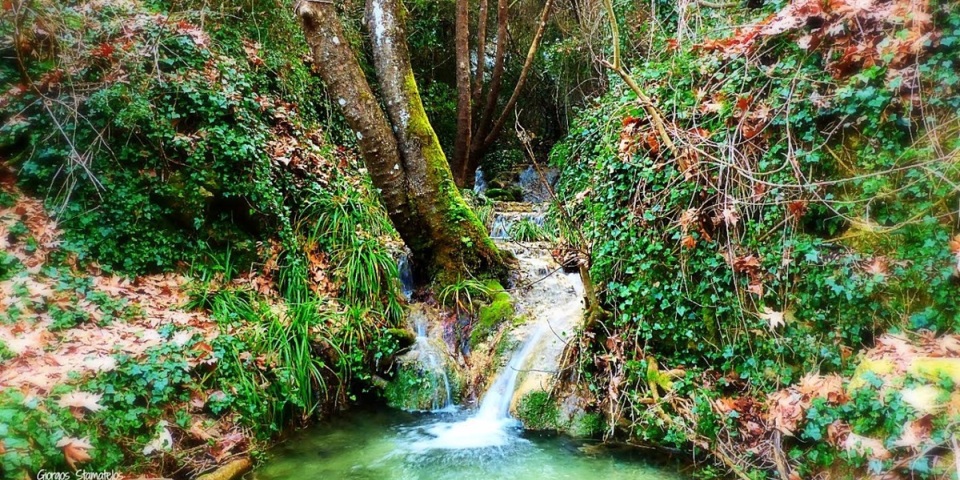
The area is crossed by a rushing torrent that feeds 6 other watermills of the 64 that were in operation on the island in 1814. All the watermills are located one after the other in the same valley and according to testimonies they worked in winter and spring using the surface waters of the torrents.
The watermills are one-roomed small houses built with paddocks. For openings they have a door and one, rarely two windows. The roof of the watermills was always covered with tiles and was sloping and single-pitched. Continuing along the 2 km dirt road from the entrance of the gorge, we reach the large plateau with the watermills of ’Kospetos«. From this point onwards there are 2 well-maintained paths with protective wooden railings. One trail to the left towards »Apetasti’ a site with lots of water and the other trail to the right passing the stone bridges towards «Kalo Lagadi». A magnificent route with wooden bridges and water mills. In fact, the last watermill in the row was used for processing of theiafiu.
In the gorge we can find cypresses, laurels, plane trees, oaks, holly, alder, alder, birch, wild roses, wild chickweed, myrtles, cherry trees, chrysanthemums, schistos, rowan trees, willows, willow trees, arikias, kumarias, wisteria, wicker, skunk crabs, asparagus, aspalaths, asphlakes, crocuses, etc. Of the animal kingdom, we find turtles, waders, snipe, skunks, badgers, weasels, weasels, porcupines, porcupines, pheasants, partridges, bee-eaters, chaffinches, jays, magpies, sycamores, vipers, skeeters, etc.
The type of route is relatively easy. We start from the entrance of the gorge at an altitude of 320 m and end up at the end of the path at Kako lagadi at an altitude of 150 m. The total length of the path is about 2 km and it takes about an hour to cross it.
Fryas : Location in the village of Asprogerakata where there are three large historical wells, from which all the villages of the Municipality of Sfakiotes were watered all along. There are also two century-old plane trees planted there in 1845. In the area there is also the stone church of Ascension with its magnificent bell tower. Aristotle Valaoritis writes in a verse of the poem.
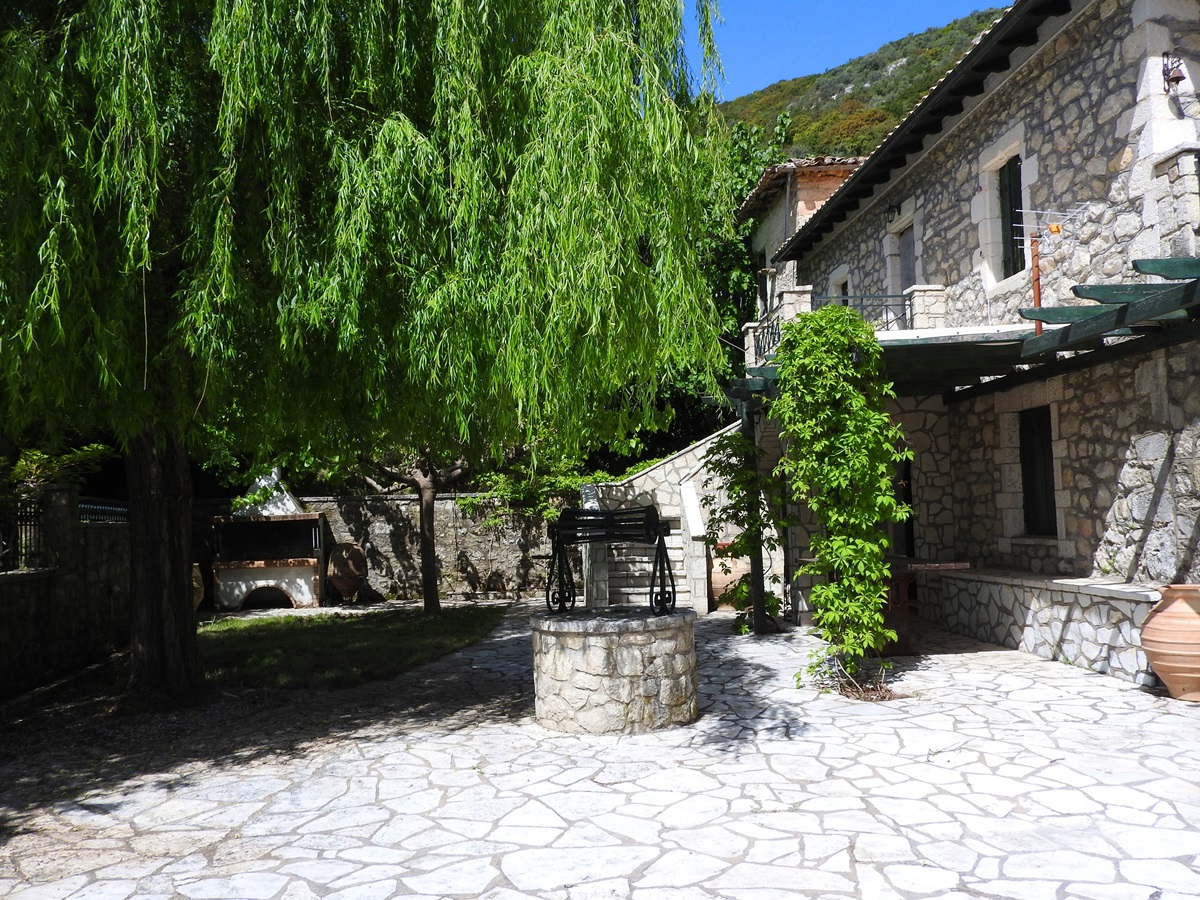
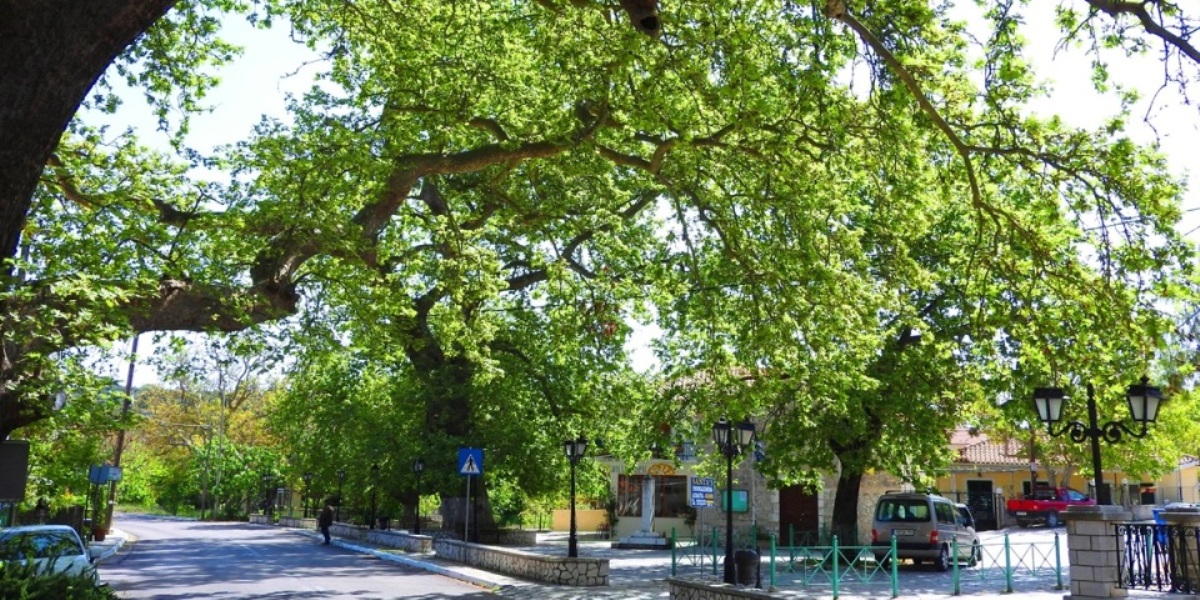
In Frya, between Kavala and Asprogerakata, there are wells of special style from the period 1478-1684. One of them, the famous ‘well of Fryas’ supplied water to all the villages of the municipality.
In Fryas there are two old-growth plane trees, which, together with the ‘well of Fryas’ - the enclosure of which was recently reconstructed according to its original, make up the characteristic physiognomy of the area.
Hiking trail of Spanochori (swallow site) to the chapel of Prophet Elias and Agios Stefanos : Starting from the location Katapotiras of Spanochori we can walk the uphill cobbled path to the chapel of Prophet Elias and then to Agios Stefanos.
The view towards the valley and the villages of the Municipality of Sfakiotes is magnificent.
The route starts at 440 altitude and ends at 540. It lasts about 35 minutes and at the top we will meet the Stone Chapel of Prophet Elias, built during the Turkish occupation (1479-1684). It is an opportunity to stop to cool off with the cold water from the deep well in its courtyard and to look out over Lefkada, Preveza and the whole Ionian Sea. Then taking a short route we come across the Chapel of Agios Stefanos which is anointed in a cave with a unique view to the eastern side of the island.
The churches of the area are among the most representative examples of the local architectural character: In Spanochori, high on the opposite hill, the old monastery dedicated to Prophet Elias. According to old documents, the ruined church was granted by the Venetian government to the priest Meletios Bonasieris, who rebuilt the monastery. Successive fires destroyed much of the monastery. It was recently repaired and is open to visitors.
Another remarkable monument of the place is the chapel of Pantokrator which is located 1 km northeast of the village of Kavalos. On its door there are lintels from ancient Greek temples. Its bell hangs from the huge oak tree in front of its courtyard. Next to the chapel there is the semi-deserted «windmill of Kospetos» and a little further on the three old «wells of Stenofryas».
Many traditional bell towers adorn the churches of Sfakiotes, each with its own special characteristics. Among the most beautiful are those of Agios Dionysios and Agios Spyridon, in Lazarata, and Agios Ioannis in Asprogerakata, built at least 150 years ago.
The church of Agios Spyridon was built in the middle of the 18th century. Its iconostasis is in baroque style, in white and gold with thin columns of Corinthian style.
The icon of Archangel Michael on the door leaf probably belongs to the hagiographer V. Sideris (1894). The bell tower, built with soft stone on three floors, is tall and imposing. The church of Agios Nikolaos in Kavalos is one of the oldest in the area.