
The church of Agia Mavra is located in the homonymous castle that is being restored to its original image and is preserved in excellent condition.
The church of Pantokrator, another private church belonging to the descendants of the Valaoritis and Stavros families with special value, is located in the centre of the market in the town of Lefkada. Its hagiographies belong to well-known Ionian hagiographers. Behind the sanctuary is the tomb of the national poet Aristotle Valaoritis, while other prominent Lefkadians are buried inside.
The church of Agios Spyridon, in the central square of the town, built in 1685, is a church of the hereditary type. It is a basilica with one room, elongated, low, without a dome, with side entrances and with obvious influences from Venetian architecture. Its iconostasis was made by the Zakynthian woodcarver I. Groppas and its icons by the Cretan, Venetian-born Tomazo Zen.
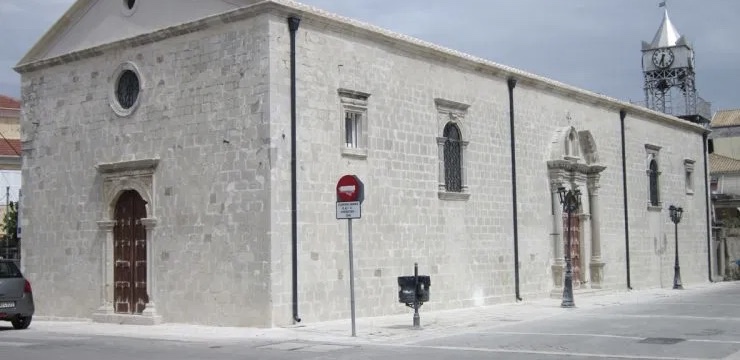
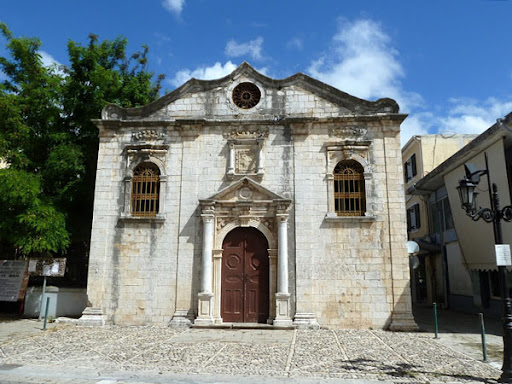
The church of Agios Minas, located at the end of the pedestrian street, stands out for its excellent wooden carved iconostasis and the icons of the great Ionian hagiographers Kontarini, Roussos, Doxaras, Koutouzi, Ventouras etc. The church in baroque style was founded in 1707 with the permission of the Venetians and originally had smaller dimensions. It was rebuilt in its present form, after being severely damaged in 1724.
The church of the Assumption of the Blessed Virgin Mary in Gyra (Panagia rinomata), located in the narrow strip of land that closes the northwestern lagoon of Lefkada. It is a one-room church with a large semicircular arch. The original temple belonging to the ancestors of Angelos Sikelianos existed here before 1684 and is considered one of the oldest on the island. It was built around 1460-1503 by the brother priests Stamatios and Athanasios Soundias, was tested by many earthquakes and later became part of the Orphanage and the Hospital of Lefkada. Its wooden iconostasis is simple and plain, while the icon of the Virgin Mary of Odigitria to which it is dedicated is the work of Tomazo Zen, with obvious elements of Byzantine tradition. Today it is the chapel of St. Nicholas of the city.
The church of Agios Nikolaos, located in the centre of the city. Built in 1687 with the permission of the Venetian authorities, it was tested by the earthquakes of the 18th and early 19th century and rebuilt in 1830. It was the richest church in the city. It has impressive entrances and windows of distinctive Baroque art. Its iconostasis is particularly imposing, and the icons are works by John Roussos at his best and Spyridon Ventura. The chapels of Agios Nikolaos are Agios Ioannis of Anjousis and Panagia of Gyra.
Other, equally important, churches in the city are the Church of the Presentation of the Virgin Mary in the central market, Agii Anargyri and Panagia Xenon in the Marka area.
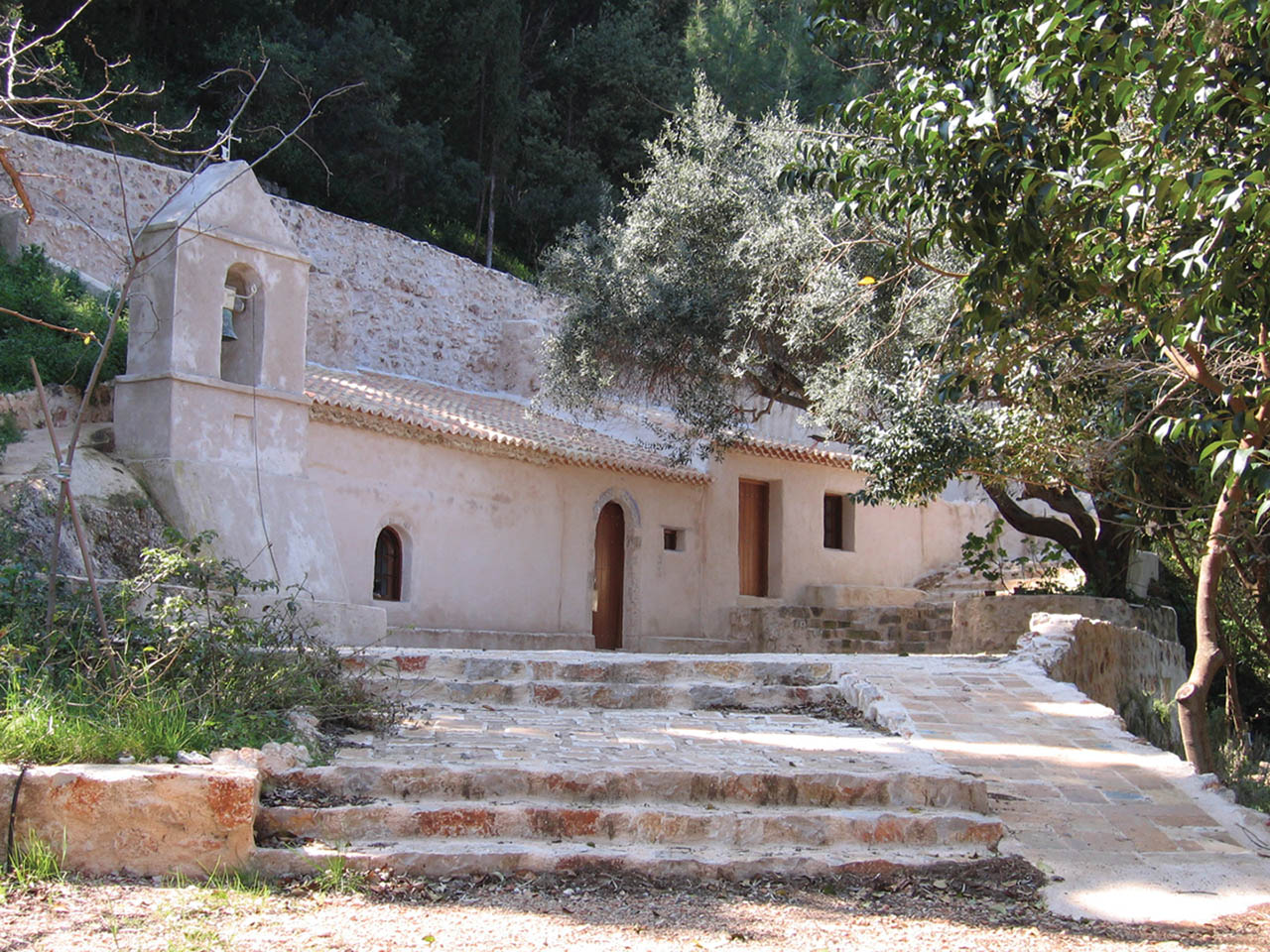

The small church of Agios Ioannis of Antzousis is located almost in a rock at the edge of the beach of Gyra, at the point where the coastline rises. Here, according to tradition, was the prayer house where the Apostle Paul himself worshipped on his way to Rome. It is one of the oldest churches on the island, renovated and extended by the Frankish Angevin knights (Anjou), who discovered it in 1331.
Nowadays there have been projects to improve the surrounding area.
In the heart of Eleonas, towards the west, is the small and historic chapel of Panagia Vlacherna, built in 1740 AD.
The owner was the family Brando, of Venetian origin, who later gave it to the Livaditis family.
An old noble family which today does not exist in Lefkada.
In the 19th century Vlaherna was granted to the Metropolis of Lefkada and since then it remains as a chapel of Panagia Xenon.
Panagia Vlaherna is a historic church for two important reasons.
In the church the swearing-in of the Friendly Fighters of the Revolution of 1821 took place on Halloween Sunday. Important persons of the National Revolution such as ANDROUTSOS, KARAISKAKIS, VARNAKIOTIS, ZAMPELIOS and others were sworn in. This swearing-in took place two months earlier than the 25th of March 1821, which is officially celebrated as the day of the Revolution.
In 1941, the offices of the Holy Metropolis of Lefkada operated in the cell located west of the church.
In Panagia of Vlaherna was the seat of the local church during the period of the Italian and German occupation.
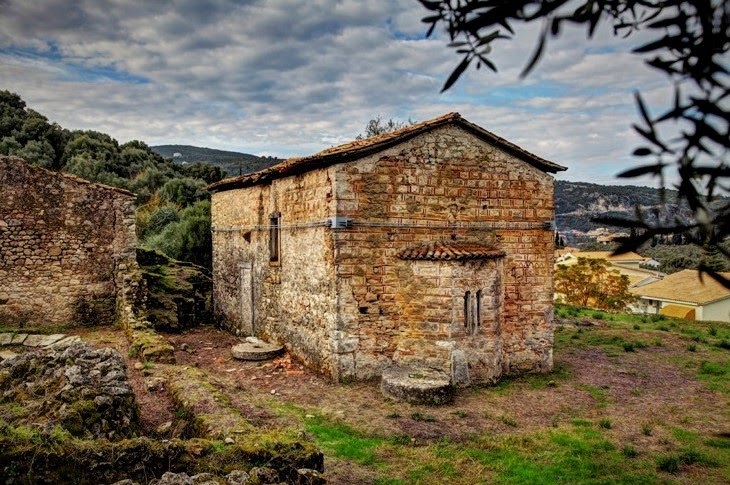
THE MONASTERY OF THE VIRGIN MOTHER OF THE GUIDE OF LEFKADA
The monastery of Panagia Odigitria in the village of Apolpina in the Municipality of Lefkada is located about 2 kilometres south of the town of Lefkada.
The complex of the monastery extends in an irregular quadrilateral area defined by a built enclosure, with an arched entrance on the SE side. Apart from the katholikon, three auxiliary buildings, now in ruins, are preserved. The first one on the east side probably housed the monks' cells, while the other two on the south-west side serve as auxiliary buildings.
The historical monastery of Panagia Odigitria of Lefkada, according to many reliable testimonies, was built in the 11th century before the fall of the city and an important role in its artistic formation was played by James Roussos, who was appointed in 1448 as the guardian of the underage heir Leonard III of the Tocchi dynasty.
Odigitria was a famous monastery of the 15th century and owes its fame mainly to the sponsorships and generosity of the Tokki dynasty, which supported and promoted the intellectual and artistic life of Lefkada.
In the 18th century a wooden carved iconostasis was added to the monastery, which survives in poor condition until the middle of the 19th century. Also at an unknown time, the exterior walls and the frescoes inside were covered with lime until 1953.
It was then that the Lefkadian historian, the late Panos Rodogiannis, first identified this unique ensemble, which remained so until 1970, when the Archaeological Society, under the supervision of Professor Dimitrios Pallas, completed its restoration.
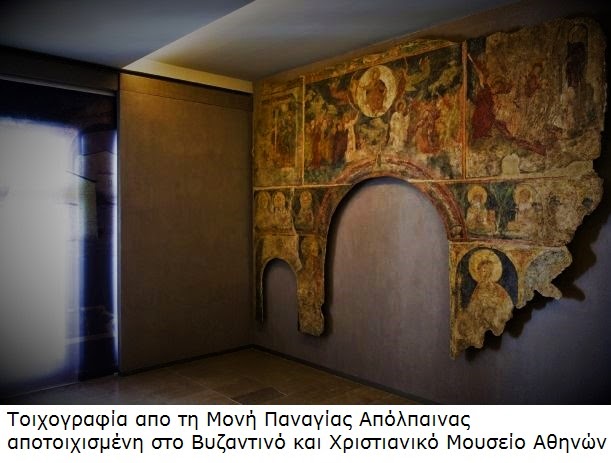
Since then, the frescoes of the church of Odigitria in Lefkada have been kept in the Byzantine and Christian Museum, which after 30 years gives the opportunity to scholars and the general public to become acquainted with this brilliant painting, the result of the fruitful coexistence of Catholics and Orthodox in the same place, as well as the particular historical circumstances of Lefkada in the 15th century.